Somewhere inside the Salty Marks House, in a folder that has not yet been closed, there is a photograph from 1990. It shows a summer gathering that GIHS still calls, in its own records, the "growing up on Gibson Island" event. The people in it were donated along with the print. Their names were not.
Most residents assume the island's history is a finished thing, boxed up in the small cottage that overlooks the harbor, waiting to be visited rather than added to. That assumption is wrong in a specific and useful way. The Gibson Island Historical Society is not managing a completed archive. It is running an open one, and a surprising share of what fills it in depends on residents themselves rather than on anyone with a professional title.
The Photograph Nobody Has Finished Naming
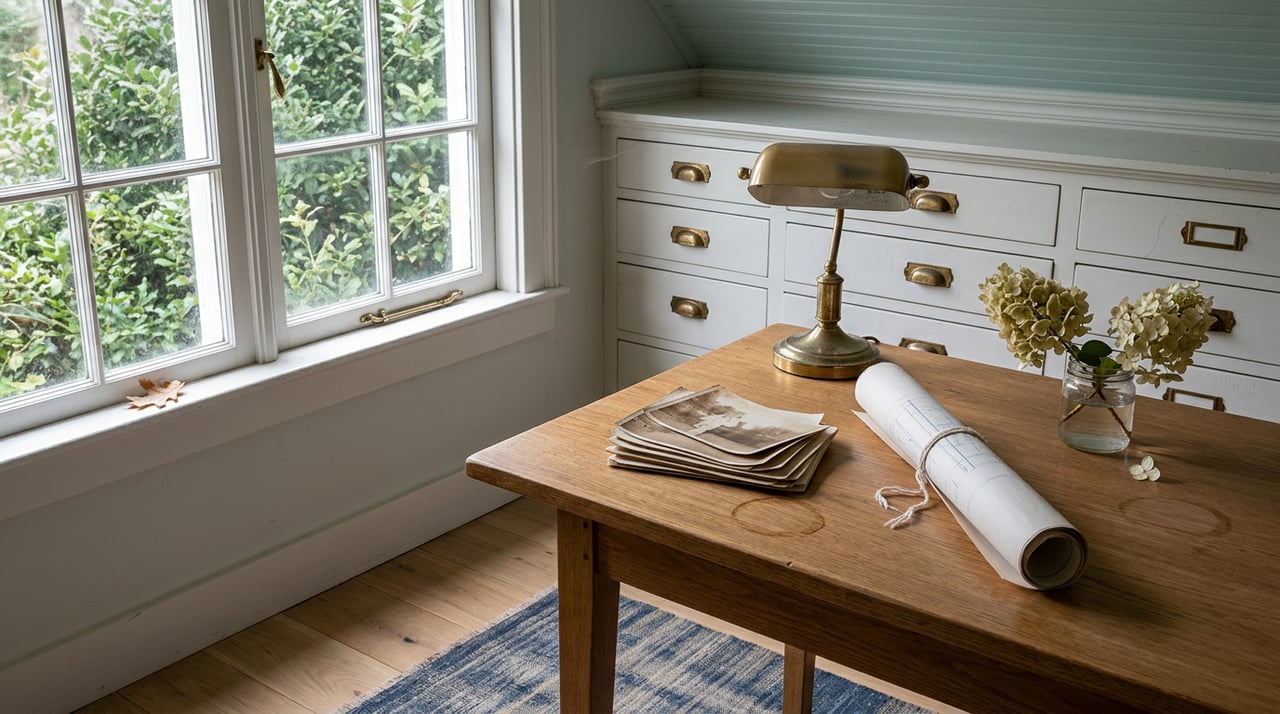
The 1990 photo is not an isolated case. GIHS has taken to posting unidentified images from its collection and asking members and neighbors to help caption them, the same way a family might pass around an old shoebox at a reunion. A 1947 watercolor, a 1924 architectural drawing, a snapshot from a decades-old summer party: each one sits in the archive with gaps that only someone who was actually there, or whose parents were, can close.
This is a different model than most historical societies run. A county archive relies on deeds and public filings that exist whether or not anyone remembers the people involved. Gibson Island's version depends on living memory in a community small enough that living memory still covers most of the last century. When that memory isn't recorded, the record stays open. That is the condition the Society is in right now, on ordinary weeks, not during some special commemorative push.
Property Lines Older Than the Symingtons
The gap in living memory is easier to accept once you see how far back the rest of the record reaches. Gibson Island's use predates every institution residents now take for granted. Native Americans used the island as a summer residence in the 17th century, and Captain John Smith sailed past it during his 1608 voyage up the Chesapeake Bay, more than three centuries before the Symington brothers bought the land and hired Frederick Law Olmsted Jr. to lay out house lots.
That older layer is not just a line in a history book. It is being physically excavated right now. The Society's James Morrison Archaeology Program underwrites professional exploration of the island's sites of historic interest, and island volunteers do the digging and on-site work alongside the archaeologists. According to the Society, the finds go back to the 1700s and 1800s, artifacts recovered from ground that now sits under lawns, driveways, and home sites that residents pass every day without knowing what was pulled out from underneath them.
It is a strange kind of layering to live with. The clubhouse, the nine remaining golf holes, the causeway itself all read as old to a visitor. On the ground, they are recent additions sitting on top of a much longer record that professional archaeology, run through a named and specific program rather than a generic parks department, is still bringing up.
A Boat Named Twice
Some of what the archive protects is smaller and stranger than an artifact. Among the Society's own favorite pieces is a 1947 watercolor by Hobart A. Walker, an architect and a founding member of New York's Nonowontuc Yacht Club, who won the Architectural League's Avery Prize back in 1894. Walker's own boat, the one that likely brought him to Gibson Island in the first place, was named Brer Rabbit.
There is also a modern catamaran that carries the same name and has nothing to do with Walker or his sloop. The Society's own archivists have had to note the distinction in writing, so that a future researcher pulling the file doesn't confuse a 1947 watercolor with a boat still sailing today. It is a small, almost bureaucratic detail, but it says something about the scale of the work. Keeping an island's record straight means untangling coincidences that would never occur to anyone outside a two-mile community where names, like water views, tend to repeat.
The House That Came From Baltimore
The Society's own visual identity has a similarly layered story. Its original logo was hand-drawn by architect and island resident Bryden Bordon Hyde, whose penciled draftsman's marks are still visible on the submission preserved in the GIHS permanent collection. Hyde's own island home is significant enough to be listed in the Historic American Buildings Survey, an honor recorded in 2004. He also designed the Gibson Island Country School, worked on renovations to St. Christopher-by-the-Sea, and rebuilt the Pavilion at The Point.
His most unusual project, though, involved a house that never started on the island at all. Hyde relocated a Baltimore residence known as Evesham so it could be lived in on Gibson Island, moving the structure itself rather than simply borrowing its design. Separately, a 1924 blueprint by architect Edward L. Palmer Jr., preserved in the GIHS archives, documents the same era of building. Palmer designed the Hugh Young house just north of the gate and the Gibson Island Clubhouse itself, alongside unrelated work for shipbuilders in Dundalk and DuPont employee housing in Wilmington. Two architects, two very different footprints, both filed at Salty Marks House because the Society treats architectural history as part of its job, not a side interest.
Who Keeps the Door Open
None of this runs on its own. GIHS was established in 1968, and its museum exhibits went through an extensive renovation in 2006, but the day-to-day work is still carried by volunteers rather than a paid archival staff. The Maisel Flores Scholarship program, funded through the Society, awards education grants specifically to employees of the Gibson Island Club, the Corporation, and the Boat Works, which means the institution's reach extends past homeowners and into the people who keep the island's infrastructure running year-round.
The museum itself keeps modest hours, open Tuesdays and Thursdays starting at 10 a.m., which is not the schedule of an institution performing history for visitors. It is the schedule of a small operation staffed by neighbors fitting archival work into an ordinary week. That is also, practically speaking, the best way to think about what the Society is: less a finished museum than a standing invitation. If a resident's grandmother appears in a photograph from the 1990 gathering, or if a family holds a letter or a logbook that fills a gap the archive has flagged, the record gets better precisely because someone walked it through the door on a Tuesday morning.
That is the part of the island's history that never quite gets said out loud. The archive is not something to visit once and consider covered. It stays open because the people who could close its gaps are still living here, and the Society is, quite literally, waiting for them to stop by.
Gibson Island Real Estate has spent decades as the island's own brokerage, and that same sense of stewardship runs through how the firm thinks about the community it works in, not just the houses on it. If a question ever comes up about a property's own past, or about how the island's history connects to a particular parcel, Sarah Kanne and the team are glad to help. Schedule a private tour and consultation.